Why Balance Training Reduces Fall Risk by 50% After 65
The Road to Independence Has Another Lane — And Most People Miss It
Last week we talked about Strength.
The exit most people miss. The reserve that determines whether life's inevitable setbacks stay setbacks — or become something you don't come back from.
This week, there's another sign up ahead.
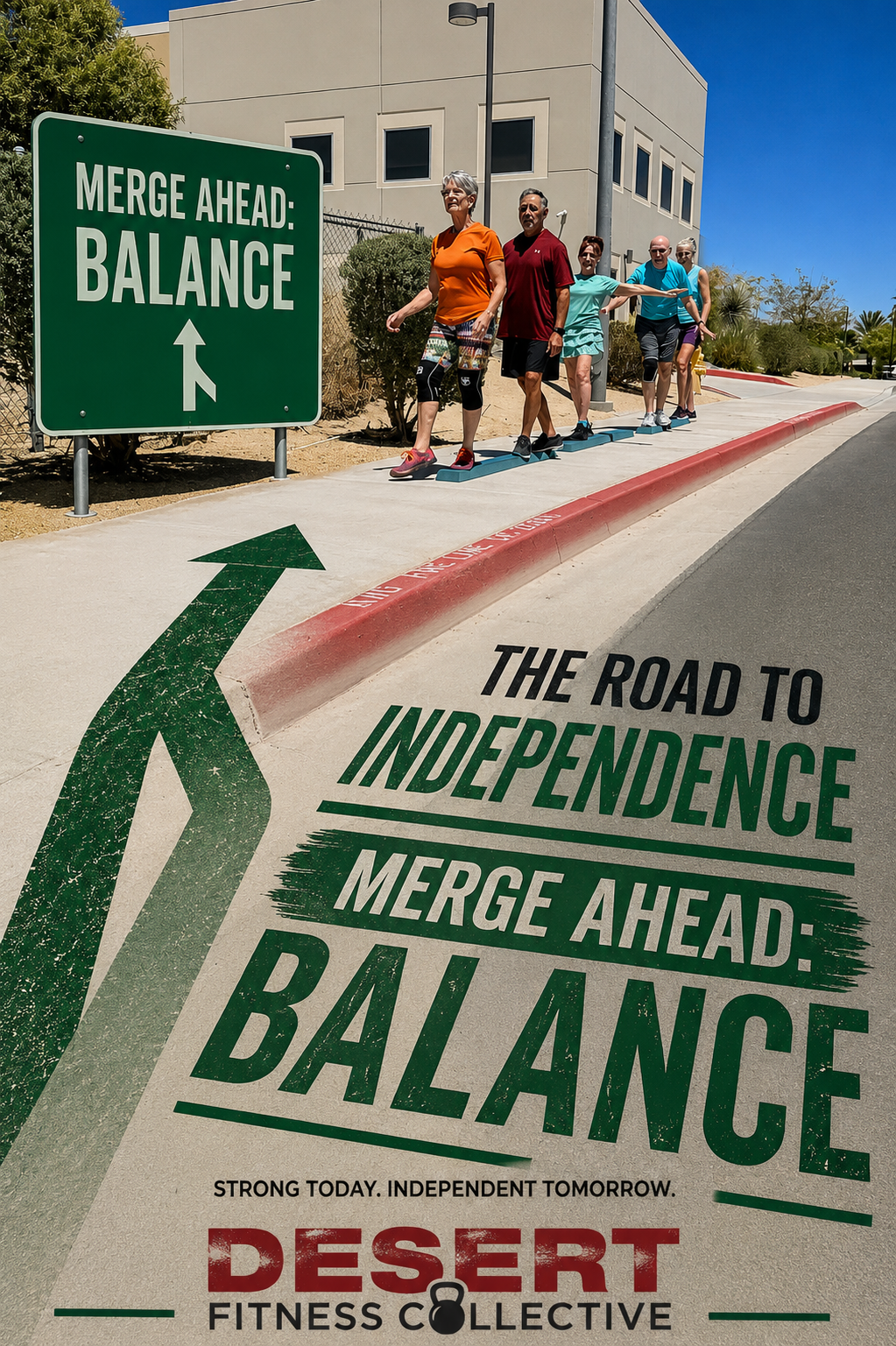
Merge Ahead: Balance.
And unlike strength — which declines quietly, gradually, over years — balance can fail in an instant.
One moment everything is fine.
The next, the floor is coming up fast.
The Numbers Are Not Small
Falls are the leading cause of injury for adults ages 65 and older. Over 14 million — one in four older adults — report falling every year.
One in four. Every year.
And falling isn't just about broken bones, though those are serious enough. Each year, nearly 319,000 older people are hospitalized for hip fractures — and 83% of hip fracture deaths are caused by falls.
Hip fractures carry a one-year mortality rate of 12–25%.
Not from the fall itself, most of the time. From what comes after — the surgery, the immobility, the rapid muscle loss during recovery, the infection risk, the loss of confidence, the fear of moving again.
A fall is rarely just a fall.
For older adults, it's often a turning point.
Why Balance Fails — and Why It's Not Inevitable
Balance isn't a single skill. It's a system — a constant, real-time negotiation between your eyes, your inner ear, the nerve endings in your feet and joints, and the muscles that respond to all of it in fractions of a second.
When any part of that system weakens, the whole thing gets less reliable.
After 65, several things happen simultaneously: peripheral sensation decreases, reaction time slows, and the muscles responsible for rapid postural correction — catching yourself before a stumble becomes a fall — begin to decline.
Here's what makes this different from strength loss: those with consistently lower balance times were at greater risk — more than three times the risk — of recurrent falls compared to those who could balance well, with associations that tracked over years, not just at a single point in time.
Poor balance today predicts poor balance — and falls — in the future.
But here's the part that matters most.
Balance Is Trainable
This is not a fixed fate. It is a trainable physical skill — and the research on this is among the most consistent in all of aging science.
A systematic review examining 27 randomized controlled trials found that structured exercise interventions consistently reduced fall incidence across every study included. Tai Chi was associated with 31–58% reductions in falls. The Otago Exercise Program showed 23–40% reductions. Multimodal strength-balance training produced 20–45% reductions.
That's not a modest improvement. That's cutting your fall risk nearly in half — with training.
And a Frontiers in Public Health systematic review of community-dwelling older adults specifically found that strength, balance, and aerobic-based training reduced falls by up to 50%, with gains that may last as the training is maintained.
Up to 50% fewer falls. From showing up and doing the work.
What Balance Training Actually Looks Like
It is not standing on one leg and hoping for the best.
Real balance training — the kind that changes fall risk — challenges your postural control system deliberately and progressively. Single-leg variations. Unstable surfaces. Moving while maintaining position. Reacting to unexpected shifts. Carrying something while changing direction.
These aren't party tricks. They're your nervous system learning to respond faster, your muscles learning to fire more precisely, your whole body learning to catch itself before you even know you've stumbled.
Balance and strength training together improves postural control, gait stability, and neuromuscular coordination — and that combination, trained together, is consistently more effective than either alone.
Which is why at Desert Fitness Collective, balance isn't a separate class or an afterthought.
It's built into the program. Because strength without balance is a car with no steering. And balance without strength is a car with no engine.
You need both lanes to stay on the road.
The Merge
The road to independence has multiple lanes.
Strength keeps you above the threshold. Balance keeps you from going off the road entirely.
Together, they don't just reduce your risk of falling.
They change what's possible — the travel, the stairs, the grandchildren, the ordinary Tuesday that stays ordinary because your body handled what life threw at it without drama.
That's the merge.
That's what we build.
Strong Today. Independent Tomorrow.
Ready to find out which lanes you're actually in?
We'll run a real balance and strength assessment and show you exactly where to start.
We're in this together!
❤️ Cheryl
Sources: CDC Falls Data (2026) — 14 million annual falls, leading cause of injury; CDC/Journal of Aging and Health (2023) — 319,000 hip fracture hospitalizations, 83% fall-caused; PMC hip fracture mortality review — 12–25% one-year mortality; Cooper et al., PMC British Birth Cohort (2023) — balance time and 3x recurrent fall risk; Leirós-Rodríguez et al., PMC systematic review (2025) — 27 RCTs, Tai Chi/Otago/multimodal fall reductions; Frontiers in Public Health systematic review (2023) — up to 50% fall reduction with maintained training; MDPI multidisciplinary review (2024) — balance and strength training combined outcomes

Start Getting In Better Shape

Submit Your Info
Get to know each other. Learn about our program. Get a personalized plan.

Submit Your Info
Get to know each other. Learn about our program. Get a personalized plan.

Follow Our Plan
Exercise at least 3x/wk, follow our nutrition steps, communicate with your coach.
Follow Our Plan
Exercise at least 3x/wk, follow our nutrition steps, communicate with your coach.

Reach Your Goal
Love the way you look, feel strong, fit, and live more active.
Reach Your Goal
Love the way you look, feel strong, fit, and live life on your terms!
About Us
We help seniors take the guesswork out of exercise so they can achieve their fitness goals. With our coaching program, you will confidently workout, nourish your body, and stay committed to your goals, without spending a fortune on a personal trainer.
Do you want help transforming your body and fitness?
Affiliations


2024 Copyright © Desert Fitness Collective: Senior Fitness in Palm Desert
About Us
We’ll help you take the guesswork out of staying in shape so you can achieve your fitness goals. With our coaching program, you will confidently exercise, meal plan, and stay committed to your goals, without spending a fortune on a personal trainer.
Do you want help to transform your body and fitness?
Affiliations