Get Back Up. Keep Living. — Why Floor-Rise Ability Is the Skill Every Senior Needs
Get Back Up. Keep Living. — Why Floor-Rise Ability Is a Skill You Can Train
What Happens After the Fall Is as Important as the Fall Itself
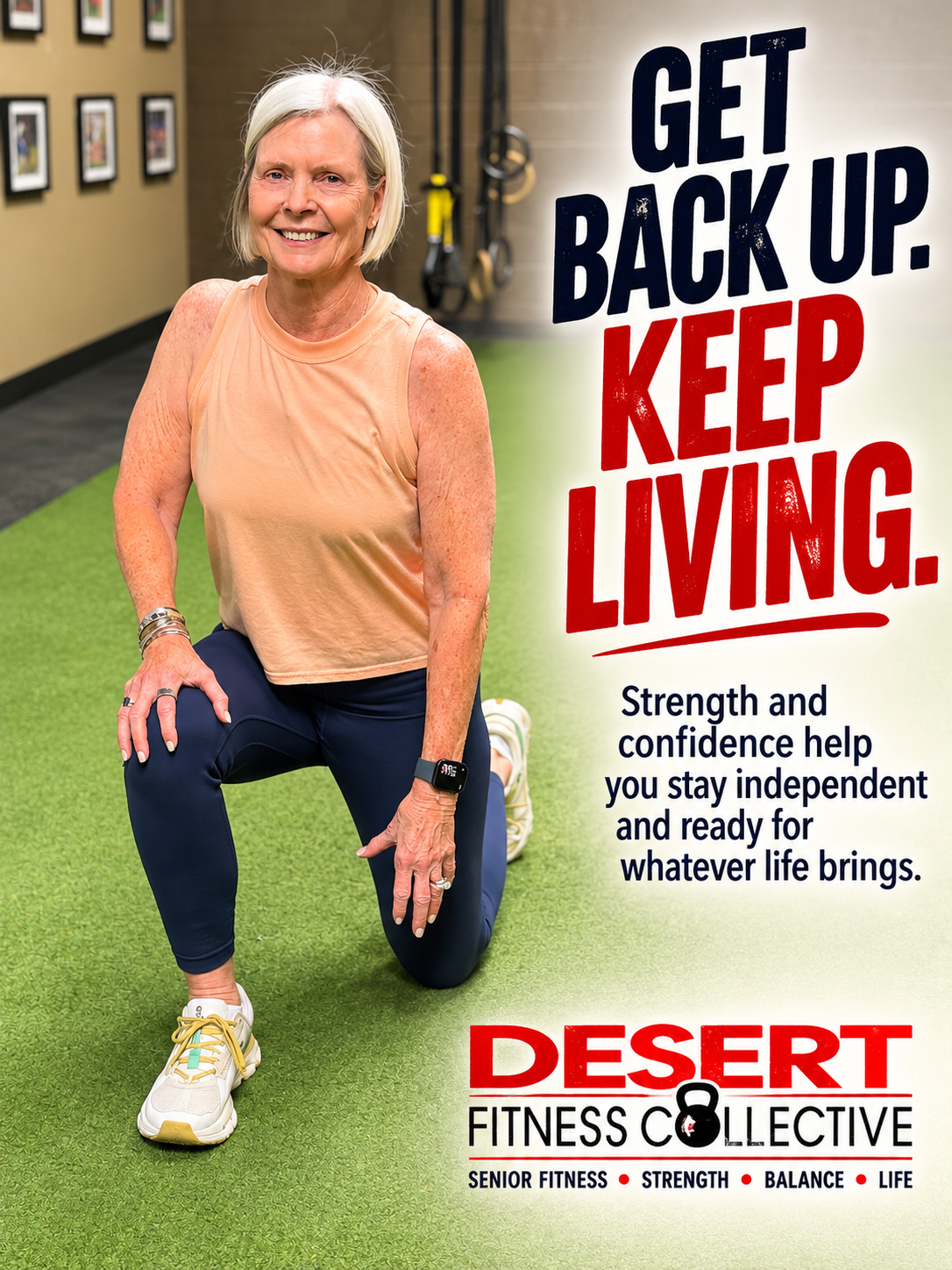
Look at where she is.
One knee on the turf. Hands relaxed. Smiling.
She’s not struggling. She’s not scared. She’s not frozen in place wondering how she’s going to get back up.
She’s just — there. Comfortable on the ground, in control, ready to move when she’s ready.
That comfort didn’t happen by accident.
It was trained.
The Statistic Nobody Prepares For
We talk a lot about preventing falls.
We talk about balance training, grip strength, reaction time, hip stability — all the physical qualities that reduce the likelihood of going down in the first place.
But here’s the statistic that almost never comes up in those conversations:
Nearly half of older adults cannot get up from the floor after a fall — even when they aren’t injured.
A 2025 study published inGeriatricsconfirmed it: floor-to-stand transfer ability is associated with falls, physical function, hospitalization, need for caregiver support, and even mortality.
In a cohort study of over 1,100 older adults, 47% of non-injured fallers reported inability to get up after at least one fall — and those who couldn’t get up were significantly more likely to suffer lasting decline in activities of daily living compared to those who could.
The fall didn’t disable them. The inability to get up did.
What Happens When You Can’t Get Back Up
This is the part of the conversation most people find hardest to sit with.
Up to two-thirds of older adults who fall cannot get up on their own — and most of those who stay down remain on the floor for more than an hour.
We’ve covered this before: the one-hour threshold matters enormously. Seniors who remain on the floor for more than an hour after a fall have a 50% higher six-month mortality rate — not from the fall itself, but from what follows: dehydration, pressure injuries, hypothermia, muscle breakdown, pneumonia, the psychological devastation of lying there and not being able to do anything about it.
A fall is an event. A long lie is a spiral.
And the difference between the two is often a single trainable skill.
The Part Nobody Tells You
Getting up from the floor is not a mystery your body either knows or doesn’t.
It is a learned motor skill — a movement pattern that can be taught, practiced, and retained with remarkably little training.
A 2024 pilot randomized controlled trial found that just 3 to 5 sessions of structured floor-rise training significantly improved older adults’ floor-rise ability, reduced the time required to complete the transfer, and improved their perceived ability to manage recovery after a fall.
Three to five sessions.
Not months of rehabilitation. Not an intensive clinical program. A small number of deliberate practice sessions — the kind that fit into an existing fitness program — produced meaningful, measurable results.
The world guidelines for falls prevention and management for older adults have specifically noted the importance of being able to get up from the floor independently to avoid harm from long lies — and now explicitly recommend that older adults practice this skill.
It is possible to regain this skill at any age, with the right approach.
What Getting Up Actually Requires
The floor-to-stand transfer looks simple. It is not.
A 2025 biomechanics study analyzing how healthy older adults rise from the floor independently identified the movement demands clearly: the most common strategy involves rolling, transitioning through a half-kneeling position — exactly the position in that photo — and pressing to standing using leg strength, hip mobility, and core stability in sequence.
That half-kneeling position is the pivot point. It requires:
Adequate knee flexion and ankle dorsiflexion to get there. Hip flexor and glute strength to control the transition. Core stability to maintain position under load. Enough confidence to commit to the movement without freezing.
Every single one of those requirements is trained in a functional strength program.
The woman in that photo isn’t in a clinical setting. She’s on the turf at Desert Fitness Collective, in the middle of a session, in a position she visits regularly — because we practice it deliberately, because the research says it matters, and because the day she needs it, we want it to be automatic.
Why This Is a Physical Freedom Issue
Every image in this campaign has shown what Physical Freedom looks like when things are going well.
The golf course. The staircase. The grocery bags. The trail. The floor with the grandchild.
This one shows something different — and equally important.
Physical Freedom isn’t just what you can do when life cooperates.
It’s what you can do when it doesn’t.
When you stumble. When you go down. When you end up on the floor somewhere and need to get back up.
The ability to recover — to get back up, assess, and keep living — is as much a part of physical freedom as any trail or any staircase.
It’s what keeps a bad moment from becoming a turning point.
The Fall Workshop
This is exactly why we’re building a dedicated fall safety program at Desert Fitness Collective — a structured class specifically designed to teach adults 60+ the techniques, the practice, and the confidence to get back up after a fall independently.
Not just fall prevention. Fall recovery.
Because preventing falls is important. And knowing what to do when prevention isn’t enough is essential.
If you’re interested in the fall recovery workshop — for yourself, for a parent, for a friend who lives alone — Click BELOW We’ll let you know when it launches.

Get Back Up. Keep Living.
Strong Today. Independent Tomorrow. Free for Life.
— Cheryl
Sources: Melchior et al., Geriatrics (2025) — floor-to-stand transfer ability, nearly half of older adults unable to rise after non-injurious fall, association with ADL decline, hospitalization, mortality; Tinetti & Liu, PubMed cohort study (1993, n=1,103) — 47% of non-injured fallers unable to rise, lasting ADL decline; Croucher et al., Age and Ageing (2024) — 3–5 session floor-rise training RCT, significant improvement in floor-rise ability and PAMF; Sol’Up balance workshop protocol (2026) — up to two-thirds of older adults unable to rise after fall, long-lie complications; NIHR Evidence (2022) — floor-rise as trainable skill, independence and confidence benefits

Start Getting In Better Shape

Submit Your Info
Get to know each other. Learn about our program. Get a personalized plan.

Submit Your Info
Get to know each other. Learn about our program. Get a personalized plan.

Follow Our Plan
Exercise at least 3x/wk, follow our nutrition steps, communicate with your coach.
Follow Our Plan
Exercise at least 3x/wk, follow our nutrition steps, communicate with your coach.

Reach Your Goal
Love the way you look, feel strong, fit, and live more active.
Reach Your Goal
Love the way you look, feel strong, fit, and live life on your terms!
About Us
We help seniors take the guesswork out of exercise so they can achieve their fitness goals. With our coaching program, you will confidently workout, nourish your body, and stay committed to your goals, without spending a fortune on a personal trainer.
Do you want help transforming your body and fitness?
Affiliations


2024 Copyright © Desert Fitness Collective: Senior Fitness in Palm Desert
About Us
We’ll help you take the guesswork out of staying in shape so you can achieve your fitness goals. With our coaching program, you will confidently exercise, meal plan, and stay committed to your goals, without spending a fortune on a personal trainer.
Do you want help to transform your body and fitness?
Affiliations