
Keep Growing: How Strength Training Helps Seniors Garden for Life
Keep Growing — Why Gardening Is Serious Physical Work and How to Keep Doing It for Life
That Watering Can Is Heavier Than It Looks
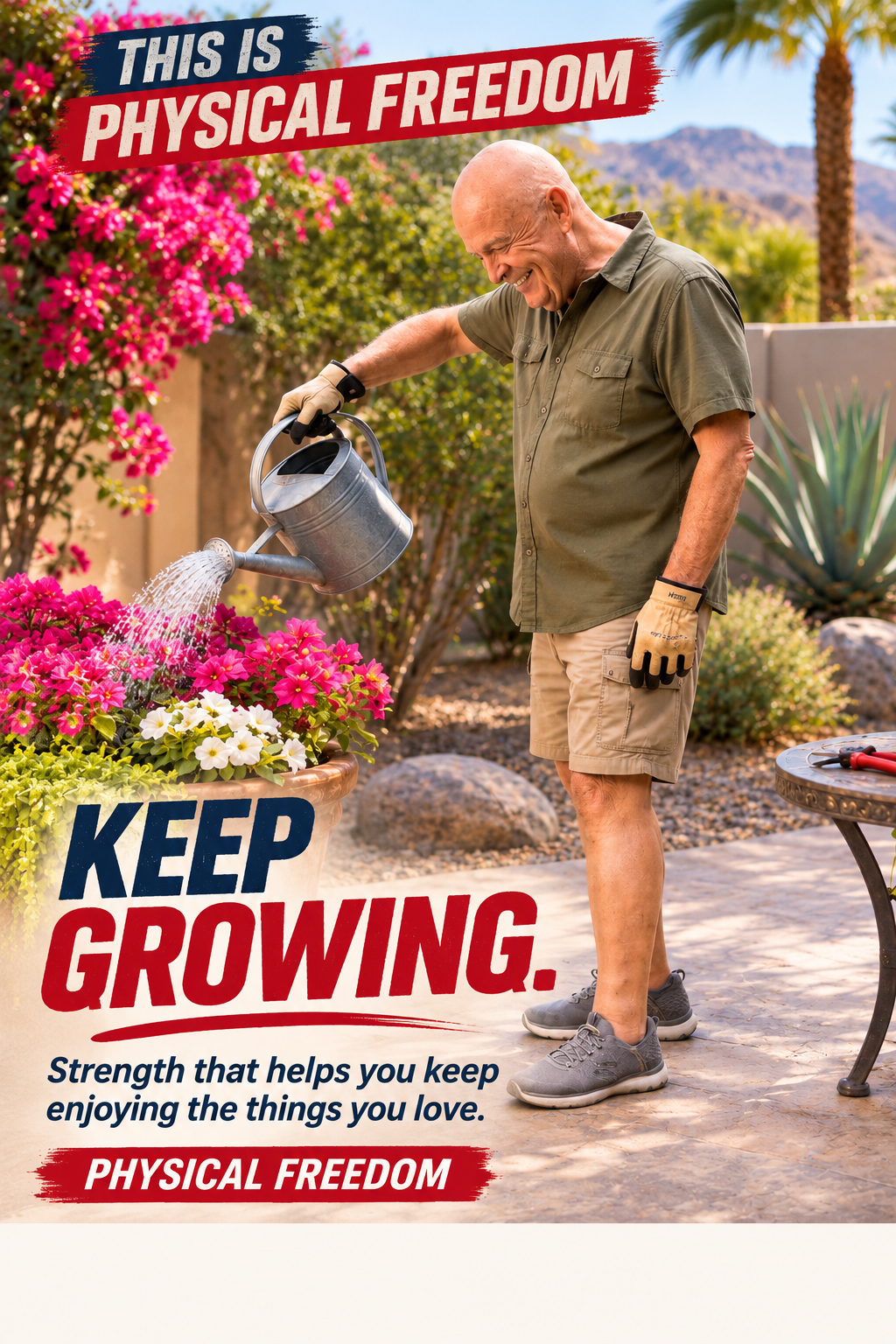
Look at him.
Garden gloves on, olive shirt, cargo shorts — completely at home in his desert courtyard. Bougainvillea blazing pink behind him, agave standing tall, the Santa Rosas in the distance. He’s watering his flowers, smiling, in no particular hurry.
This is Physical Freedom.
And that full metal watering can — a standard gallon holds about eight pounds, two gallons closer to seventeen — is a loaded carry, a grip endurance challenge, and a postural stability test happening simultaneously, in his garden, on a Saturday morning.
Gardening looks gentle. The research says otherwise.
What the Data Says About Gardening and Longevity
A 25-year longitudinal study tracking the Lothian Birth Cohort from age 79 into their 90s found that frequent gardeners had a 22% lower mortality risk than those who rarely or never gardened.
Frequent gardeners had a 22% lower mortality risk — and that association persisted after adjustment for general physical activity, education, and baseline health status.nihsciencedirect
That last detail matters enormously.
The benefit wasn’t explained by the fact that gardeners simply moved more. Gardening was offering something above and beyond general physical activity — something in the combination of purposeful movement, nature exposure, cognitive engagement, and physical challenge that researchers described as unique protective benefits for aging.
A 2026 longitudinal study also showed that frequent gardening was linked with longer telomeres — the protective structures at the ends of chromosomes that tend to shorten with biological aging.National Geographic
Frequent gardeners were aging more slowly at the cellular level.
And a large-scale analysis of the 2019 Behavioral Risk Factor Surveillance System found that among adults 65 and older, gardeners had significantly lower odds of cardiovascular disease, stroke, and diabetes — and 61% lower odds of high 10-year mortality risk — compared to non-exercisers.nih
The garden is good medicine. But only if your body can handle what it asks.
What Gardening Actually Demands
Here’s what most people don’t appreciate about their Saturday morning in the garden:
Research observing older adults during gardening tasks found that gripping occurred in 88% of activities and bending in more than 80%.researchgatecdc
Gripping. Bending. Over and over, for an hour or two, in positions that challenge your spine, your hips, your shoulders, and your hands simultaneously.
A full watering can holds 10 liters — that’s 22 pounds. Carrying it from the spigot to the bed requires grip strength, core stability, and walking endurance all at once — the same functional demands as a loaded farmer’s carry in a gym.nevertoooldtolift
Pulling deep-rooted weeds requires grip strength and shoulder stability under load. Bending to plant, prune, or deadhead requires a controlled hip hinge and lumbar stability. Getting down to ground level and back up — something we covered in depth two weeks ago — draws on the same floor-to-stand mechanics that predict independence and fall recovery.
Here’s the insight that changes how you think about strength training for gardening: when you build strength in the gym, your capacity increases — but the demands of gardening stay the same. That 20-kilogram bag of compost is still 20 kilograms. But it becomes 40% of your capacity instead of 85%.nevertoooldtolift
That difference — 85% of max effort versus 40% — is the difference between finishing a full morning in the garden feeling satisfied and finishing it completely depleted, or not finishing at all.
The garden doesn’t get easier when you get stronger. You get more capable than the garden requires.
Why Men Need to Hear This
This is the first time in the Physical Freedom campaign we’ve featured a man.
That’s intentional.
Research on over 3,000 older adults found that older adult women gardened significantly more frequently than older adult men — and that addressing barriers to gardening in older adult men specifically was identified as a priority area for future research.nih
Men over 65 are significantly less likely than women to seek out fitness programming, less likely to self-identify as someone who needs to work on balance and functional strength, and more likely to discover the limits of their physical capacity through an activity they love — golf, hiking, yard work — rather than through a clinical assessment.
The garden is often where men first notice the gap.
The bag of mulch that used to be easy. The hour of weeding that now wipes them out for the rest of the day. The getting up from the ground that requires finding something to hold onto.
These aren’t signs of inevitable decline.
They’re signs of a strength reserve that’s gotten too thin — and a training gap that’s absolutely closeable.
The Strength Behind the Garden
Pushing a wheelbarrow challenges your grip, core, and leg drive simultaneously. Pulling weeds requires grip strength and shoulder stability. Bending and kneeling demands hip and knee flexibility. Carrying watering cans engages your arms, shoulders, and core at once.vintagefitness
Every one of those demands has a direct gym equivalent.
Deadlifts for the hip hinge. Farmer’s carries for the loaded walk. Rows and pull-downs for the pulling pattern. Single-leg work for the postural stability that keeps you steady on uneven garden surfaces. Core anti-rotation work for the twisting demands of digging and raking.
We don’t program these exercises for their own sake. We program them because they’re what keeps the garden — and everything else — available to you.
At Desert Fitness Collective, we train the movements that show up in real life. The golf course. The staircase. The trail. The grandchildren’s floor. The grocery bags.
And the garden.
Because Physical Freedom isn’t just about what your body can do when life is easy.
It’s about keeping the things that bring you joy fully within reach — for as long as possible.
Keep Growing.
Strong Today. Independent Tomorrow. Free for Life.
Ready to build the strength that keeps your garden — and your life — growing? Click BELOW or DM us to book your free discovery call.

— Cheryl
Sources: Corley et al., Lothian Birth Cohort 1921, PMC (2026) — 25-year longitudinal study, 22% lower mortality risk in frequent gardeners, telomere length preservation; Veldheer et al., BRFSS (2022/PubMed) — 61% lower 10-year mortality risk odds in gardeners 65+; Park & Shoemaker; CDC Gardening Activities Review — gripping 88%, bending 82% of gardening tasks; Never Too Old to Lift Podcast/Dustin Jones physiotherapy research (2026) — strength reserve and gardening capacity demands; National Geographic Health (2026) — gardening and dementia risk reduction

Start Getting In Better Shape

Submit Your Info
Get to know each other. Learn about our program. Get a personalized plan.

Submit Your Info
Get to know each other. Learn about our program. Get a personalized plan.

Follow Our Plan
Exercise at least 3x/wk, follow our nutrition steps, communicate with your coach.
Follow Our Plan
Exercise at least 3x/wk, follow our nutrition steps, communicate with your coach.

Reach Your Goal
Love the way you look, feel strong, fit, and live more active.
Reach Your Goal
Love the way you look, feel strong, fit, and live life on your terms!
About Us
We help seniors take the guesswork out of exercise so they can achieve their fitness goals. With our coaching program, you will confidently workout, nourish your body, and stay committed to your goals, without spending a fortune on a personal trainer.
Do you want help transforming your body and fitness?
Affiliations


2024 Copyright © Desert Fitness Collective: Senior Fitness in Palm Desert
About Us
We’ll help you take the guesswork out of staying in shape so you can achieve your fitness goals. With our coaching program, you will confidently exercise, meal plan, and stay committed to your goals, without spending a fortune on a personal trainer.
Do you want help to transform your body and fitness?
Affiliations