
Keep Exploring — How Strength Training Keeps Seniors Trail-Ready After 65
Keep Exploring — Why the Desert Trail Is the Best Gym You’re Not Using
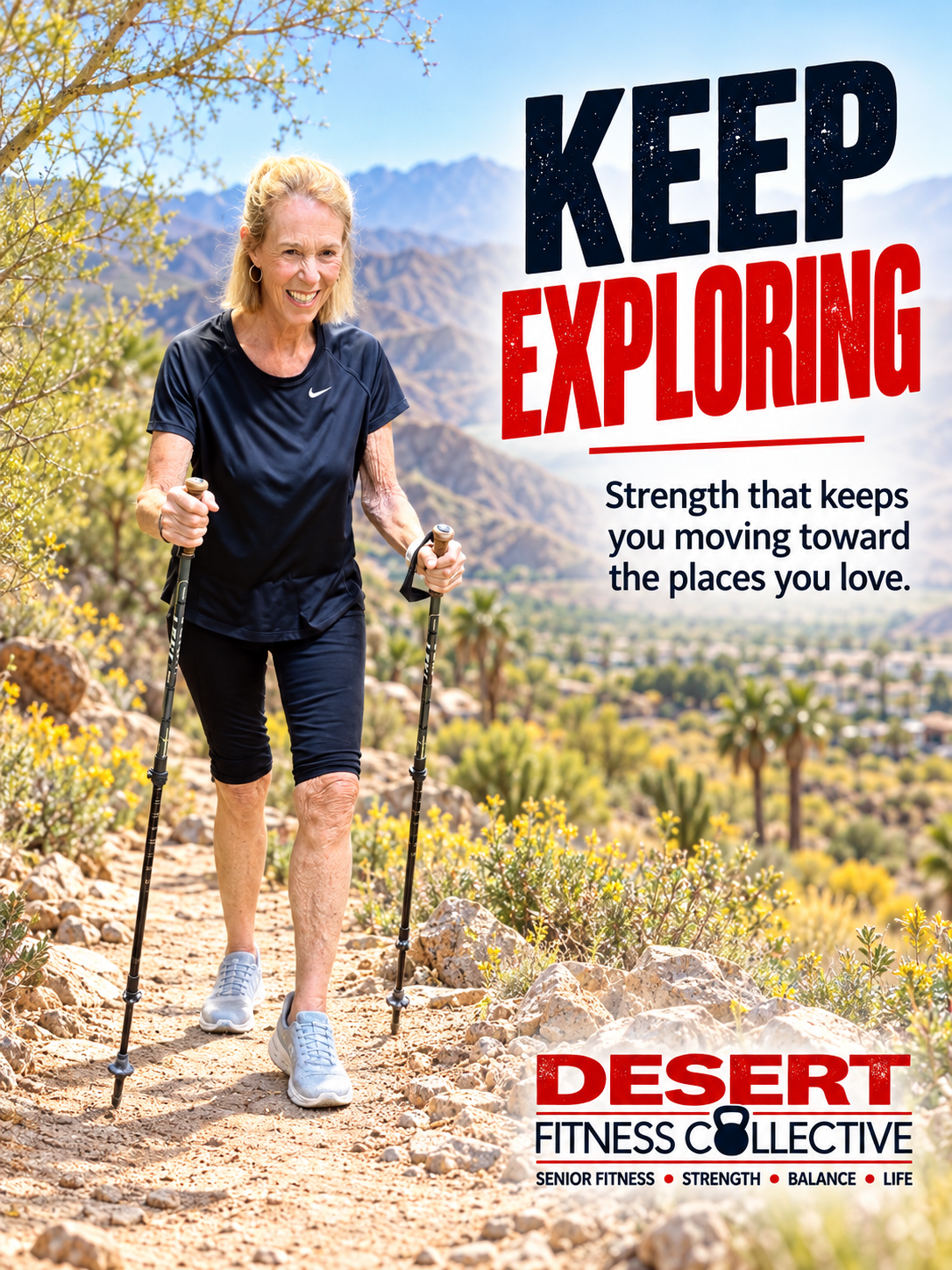
Look at where she is.
Not on a treadmill. Not on a smooth park path. On a rocky desert trail above the valley floor — poles planted, lead foot navigating loose ground, Santa Rosa Mountains behind her, the whole Coachella Valley spread out below.
That smile is the kind that comes from being somewhere you love — and having a body that got you there.
This is Physical Freedom. And the trail she’s walking on is doing something a flat sidewalk never could.
What Rocky Terrain Does That Flat Ground Can’t
Walking on uneven surfaces — rock, gravel, root, variable grade — activates something most gym equipment and smooth walking paths don’t meaningfully challenge:
Proprioception.
Proprioception is your body’s internal positioning system — the network of sensors in your muscles, tendons, and joints that tells your nervous system where you are in space and triggers the micro-corrections that keep you upright, stable, and moving efficiently.
When proprioception works well, it’s invisible. Your foot lands on an uneven rock, your ankle adjusts, your hip compensates, your core stabilizes — all in fractions of a second, below the level of conscious thought.
When it doesn’t work well, the consequences show up as hesitation on uneven ground, a stumble on a curb, an ankle rolled on a rough parking lot. Research confirms that loss of reliable proprioception is a key factor in why older adults are more likely to sway and fall — and that this decline is trainable, not inevitable.
A study comparing lower-functioning and higher-functioning older adults on uneven terrain found that step duration variability roughly doubled as terrain unevenness increased — but that effect was significantly worse in lower-functioning adults, whose gait variability on rocky terrain was nearly twice that of higher-functioning peers.
In other words: the trail separates the bodies that have been trained from the ones that haven’t. Quickly and honestly.
What the Research Says About Hiking for Older Adults
The evidence on hiking specifically — not just walking, but purposeful movement on varied terrain — is genuinely strong.
A randomized clinical trial found that older adults participating in hiking interventions experienced significant improvements in physical fitness, balance, and quality of life — with results strong enough for the researchers to describe hiking as a model of healthy aging.
Regular hiking can improve balance by up to 21% in older adults — directly reducing fall risk, which we’ve covered is the leading cause of injury-related hospitalization for adults 65 and older.
And the cardiovascular data is equally compelling: research published in the American Journal of Lifestyle Medicine found that seniors who hike regularly can lower their risk of heart disease by up to 35%.
A 30-minute hike can reduce systolic blood pressure by four to ten points and diastolic by five to eight points — numbers that rival or exceed many pharmaceutical interventions for blood pressure management.
And Then There’s the Brain
Rocky terrain hiking asks more of your brain, not just your body.
Uneven terrain walking requires continuous cognitive and physical effort simultaneously — you can’t zone out the way you can on a treadmill. Every step is a real-time problem your nervous system is solving. Research has found that slower uneven terrain walking speed in older adults is associated with poorer working memory performance — and conversely, that hiking interventions improve attention, working memory, and cognitive flexibility.
Harvard Medical School research indicates hiking can boost memory by up to 20% through increased cerebral blood flow.
The trail isn’t just exercise. It’s one of the most comprehensive neuromuscular and cognitive challenges available — and it comes dressed as a Tuesday morning adventure.
What Makes the Trail Accessible
Here’s the honest part of this conversation.
The trail in that photo doesn’t require elite fitness. It requires adequate fitness — enough strength in the legs to handle the climb, enough hip stability to manage uneven footing, enough core control to use trekking poles effectively, enough cardiovascular reserve to sustain the effort without suffering.
That’s not an extraordinary bar. But it’s a real one.
And it’s trained in a gym, not on the trail itself.
The hip strength, single-leg stability, ankle proprioception, cardiovascular endurance, and eccentric quad control that make rocky terrain accessible are built through resistance training and purposeful movement programming — then expressed on the trail.
The gym is where you earn the desert.
The Desert Is Your Backyard
This is the part of the Physical Freedom campaign that hits closest to home — literally.
The Santa Rosa Mountains are visible from most neighborhoods in Palm Desert. The Coachella Valley Trail, Indian Canyons, the Art Smith Trail, the Bear Creek Oasis — these are right here. World-class desert terrain, accessible to anyone with a body prepared to use it.
Physical Freedom in Palm Desert means keeping the desert available to you.
Not reading about it.
Not watching someone else hike it on Instagram.
Getting out there on a Tuesday morning, poles in hand, smile on your face, the whole valley at your feet.
That’s what we’re building.
Strong Today. Independent Tomorrow. Free for Life.
Ready to build the body that keeps the desert accessible?
Click below to schedule your discovery call!

— Cheryl
Sources: Warnica et al., PMC (2022) — uneven terrain treadmill study, step variability in higher vs. lower-functioning older adults; Butterfield Trail Village/American Journal of Lifestyle Medicine — 35% lower heart disease risk, 21% balance improvement with regular hiking; Marcelino et al., GG Aging RCT (2023) — hiking and orienteering improve fitness, balance, and quality of life in older adults; Backpacker Magazine/Huffpost (2025) — proprioception decline with age, hiking as proprioceptive training; Harvard Medical School — 20% memory boost from hiking; Mayo Clinic — blood pressure reduction from 30-minute hikes

Start Getting In Better Shape

Submit Your Info
Get to know each other. Learn about our program. Get a personalized plan.

Submit Your Info
Get to know each other. Learn about our program. Get a personalized plan.

Follow Our Plan
Exercise at least 3x/wk, follow our nutrition steps, communicate with your coach.
Follow Our Plan
Exercise at least 3x/wk, follow our nutrition steps, communicate with your coach.

Reach Your Goal
Love the way you look, feel strong, fit, and live more active.
Reach Your Goal
Love the way you look, feel strong, fit, and live life on your terms!
About Us
We help seniors take the guesswork out of exercise so they can achieve their fitness goals. With our coaching program, you will confidently workout, nourish your body, and stay committed to your goals, without spending a fortune on a personal trainer.
Do you want help transforming your body and fitness?
Affiliations


2024 Copyright © Desert Fitness Collective: Senior Fitness in Palm Desert
About Us
We’ll help you take the guesswork out of staying in shape so you can achieve your fitness goals. With our coaching program, you will confidently exercise, meal plan, and stay committed to your goals, without spending a fortune on a personal trainer.
Do you want help to transform your body and fitness?
Affiliations