Keep Playing: How Strength Training Keeps Senior Pickleball Players Safe and On the Court
Keep Playing — Why Pickleball Is Worth Training For (And How to Do It Safely)
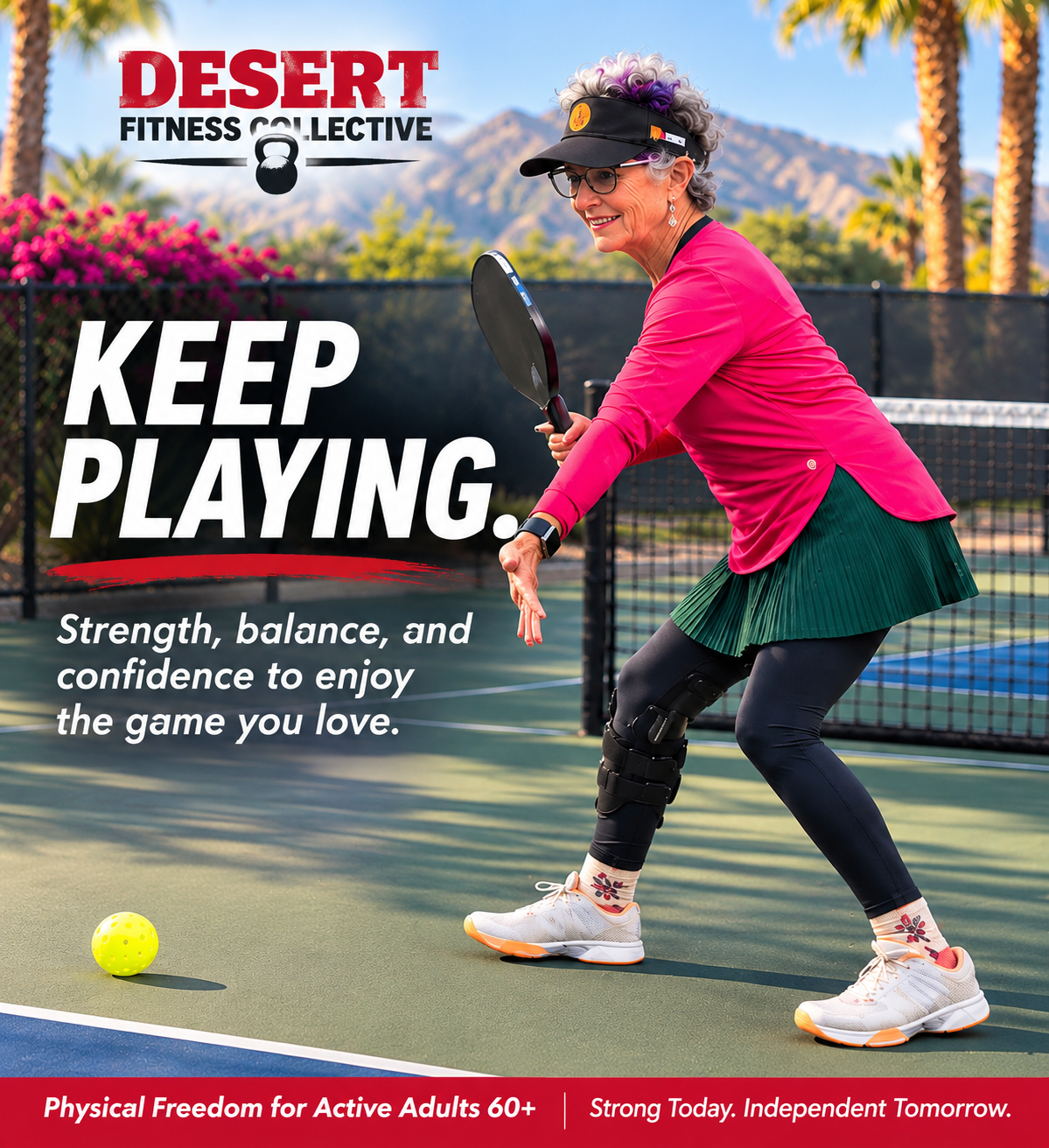
She’s Wearing a Knee Brace. She’s Still on the Court. That’s the Point.
Look at her.
Hot pink top, green skirt, purple hair tucked under a visor — mid-backhand, weight transferred, eyes on the ball. The Santa Rosas behind her, bougainvillea blazing, palm trees overhead.
And a knee brace on her right leg.
That brace is not an asterisk on this photo.
It’s the whole point of it.
Because Physical Freedom doesn’t mean a perfect body. It means a body that keeps showing up — prepared, strengthened, supported, and ready to play the game you love, whatever that takes.
The Pickleball Boom — and Its Shadow
Pickleball is the fastest-growing sport in America. It is especially popular here in the Coachella Valley, where courts have multiplied across every community, retirement development, and country club from Palm Springs to Indio.
And the research on its health benefits is genuinely impressive.
A pilot study tracking adults 65 and older who played pickleball at least twice a week found they averaged more than 68 minutes of moderate to vigorous physical activity per session — easily meeting the CDC’s recommended weekly activity guidelines in just two or three sessions. Regular participation has been linked to improved cardiovascular fitness, lower blood pressure, better balance, reduced depression rates, and stronger social connections.
Pickleball holds great promise as a physical exercise intervention for adults of all ages, due to the balance between physical challenge, comparably low injury risk, and ease of play characteristic of the sport.humankinetics
The game is good for you. That’s real. That’s worth protecting.
But here’s the shadow side that the sport’s enthusiastic growth has obscured:
Pickleball-related emergency room visits nearly quadrupled between 2018 and 2025 — and adults 65 to 74 made up the single largest share of injuries at 38.8%.valuepenguin
Adults 65 and older represented more than half of all pickleball-related ER visits over that period. And falls are the leading cause of pickleball injuries, especially among older adults — with older players nearly three times as likely to sustain fractures compared to younger players.ovid
The game is good for you. And it will find the gaps in your physical preparation faster than almost anything else.
Why Older Pickleball Players Get Hurt
The injury pattern reveals something important.
The most common mechanism of injury in older pickleball players is not overuse. It is not a dramatic collision. The most common injury mechanisms were slips, trips, falls, and dives — accounting for 64% of incidents, with older players nearly three times as likely to be injured by a slip, fall, trip, or dive compared to younger players.tandfonline
The game asks for rapid lateral movement, sudden stops and starts, low athletic positions at the kitchen line, explosive pushes from the baseline, and split-second balance corrections when the ball does something unexpected. It asks for quick-twitch muscle response, single-leg stability, and the kind of reactive balance that keeps you upright when your foot catches the court surface wrong.
These are not skills that come from playing pickleball more.
They are built in a gym, through deliberate training — and then expressed on the court.
Adults 50 and older accounted for 83.4% of all pickleball-related emergency visits not because they play recklessly, but because the neuromuscular capacity for rapid balance correction — the fast-twitch power and reactive stability that catch you before a stumble becomes a fall — declines with age without targeted resistance training to protect it.valuepenguin
The player falls. The younger player recovers. The older player goes down.
That gap is trainable.
What the Knee Brace Actually Tells You
She’s wearing a knee brace and she’s on the court.
That is not a story about limitation. That is a story about not letting limitation win.
Every player over 60 who is still on the court is managing something — a knee, a shoulder, a hip that required modification, a surgery that required recovery, a chronic condition that required adaptation.
The question isn’t whether something will happen to your body over six decades of using it.
The question is whether you’ve built enough physical reserve — enough strength, enough balance, enough neuromuscular capacity — to absorb the hits, adapt, recover, and keep playing.
A strong body doesn’t prevent all injuries. But it recovers faster. It falls less often. It returns to the court sooner. And when it does play, it moves with enough stability and power that the game is what it’s supposed to be: fun, competitive, socially rich, and worth showing up for.
That’s what we build at Desert Fitness Collective.
The Physical Foundation of a Safe, Sustainable Pickleball Game
Every component of the pickleball game maps directly to a training demand:
Lateral quickness and direction changes— require hip abductor strength, ankle stability, and reactive neuromuscular control. These are the same qualities that prevent falls on uneven terrain and curbs.
The kitchen line position— a semi-crouched, athletic stance held for sustained periods — demands quad endurance, hip stability, and the kind of isometric core control that protects the lower back.
The backhand and forehand drives— rotational power from the legs through the core to the arm — the same movement pattern as the golf swing, requiring hip mobility, anti-rotation core strength, and shoulder stability.
The explosive push from the baseline— posterior chain power, single-leg drive, and the ability to decelerate safely — the same qualities that protect knees and prevent the slips and falls that cause the majority of pickleball injuries in older adults.
Recovery between points— cardiovascular reserve and walking endurance, both directly trainable and both predictive of how long and how well you can sustain play.
None of these require you to be an athlete. They require you to be prepared.
Keep Playing
The Coachella Valley has some of the best pickleball infrastructure in the country. Courts are everywhere. Leagues run year-round. The community is real, the competition is genuine, and the social connection — which research consistently links to longer, healthier lives — is built right into the format.
This game is worth protecting.
Your access to it is worth training for.
Whether you’re playing with a brace, playing through a recovery, playing at a level you haven’t quite gotten back to yet — the goal is the same:
Stay on the court.
Keep playing.
Strong Today. Independent Tomorrow. Free for Life.
Ready to build the body that keeps you on the court?
Click below to book your free discovery call.

We're in this together!
— Cheryl
Sources: ValuePenguin (2025) — pickleball ER visits nearly quadrupled 2018–2025, adults 65–74 largest share at 38.8%; Yu et al. / Orthopaedic Nursing (2025) — falls leading mechanism in older players, 3x fracture risk vs. younger players; NC State University / Recreational Sports Journal (2023) — 68+ min MVPA per session, cardiovascular benefit for adults 65+; Journal of Physical Activity and Health scoping review (2024) — pickleball health benefits across cardiovascular, strength, balance, cognitive, and social domains; The Physician and Sportsmedicine (2025) — older players 3x more likely to sustain fractures, 2.9x more likely to be injured by falls

Start Getting In Better Shape

Submit Your Info
Get to know each other. Learn about our program. Get a personalized plan.

Submit Your Info
Get to know each other. Learn about our program. Get a personalized plan.

Follow Our Plan
Exercise at least 3x/wk, follow our nutrition steps, communicate with your coach.
Follow Our Plan
Exercise at least 3x/wk, follow our nutrition steps, communicate with your coach.

Reach Your Goal
Love the way you look, feel strong, fit, and live more active.
Reach Your Goal
Love the way you look, feel strong, fit, and live life on your terms!
About Us
We help seniors take the guesswork out of exercise so they can achieve their fitness goals. With our coaching program, you will confidently workout, nourish your body, and stay committed to your goals, without spending a fortune on a personal trainer.
Do you want help transforming your body and fitness?
Affiliations


2024 Copyright © Desert Fitness Collective: Senior Fitness in Palm Desert
About Us
We’ll help you take the guesswork out of staying in shape so you can achieve your fitness goals. With our coaching program, you will confidently exercise, meal plan, and stay committed to your goals, without spending a fortune on a personal trainer.
Do you want help to transform your body and fitness?
Affiliations