Why Senior Golfers Need Strength Training to Keep Playing Their Best
Strength Isn't Just About What You Can Lift. It's About What You Can Still Do.
What a Golf Swing Actually Reveals About How You're Aging
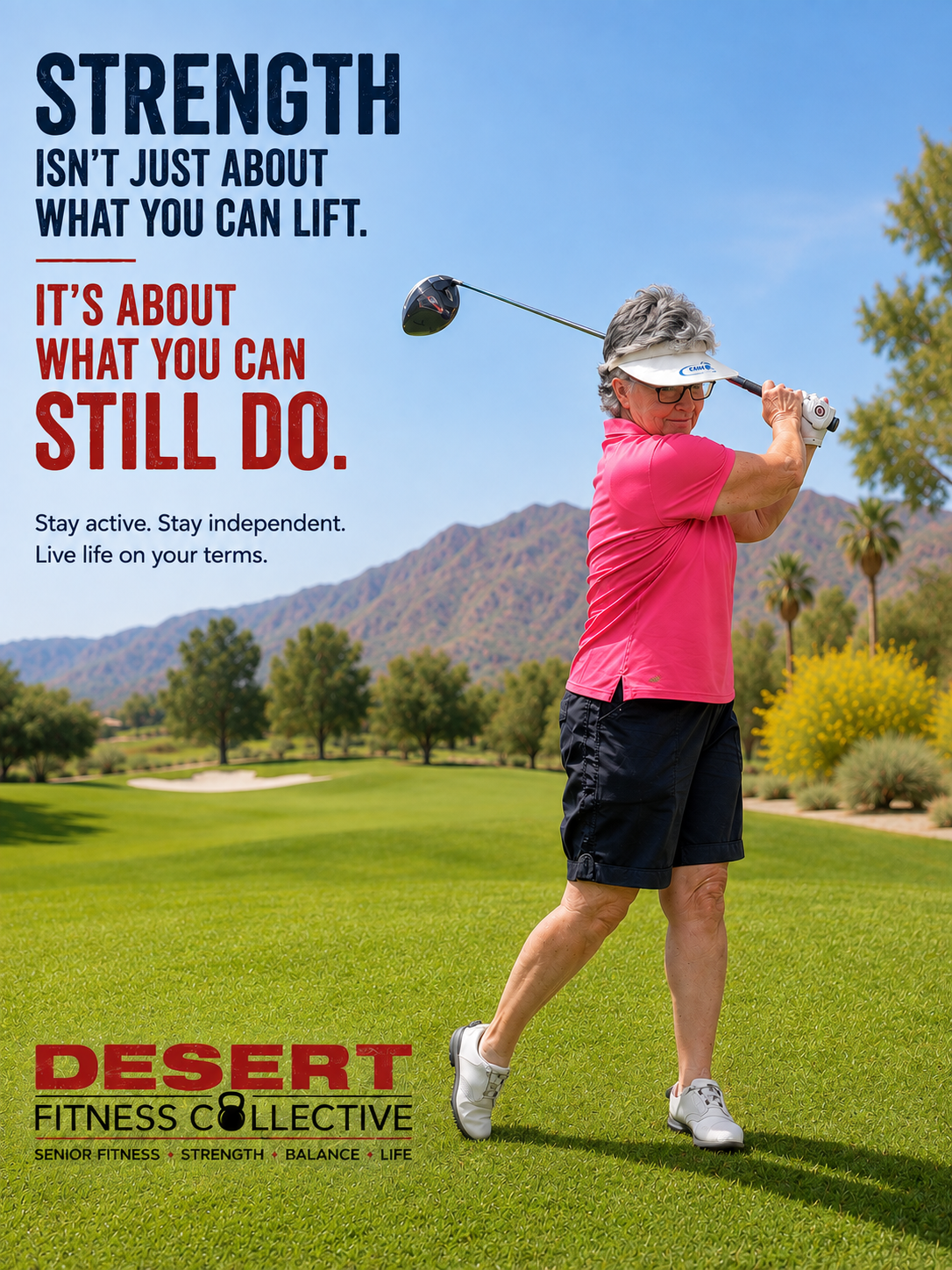
Look at that swing.
Follow-through complete. Weight shifted forward. Lead foot planted. Trail heel up. Shoulders fully rotated.
That is not a casual motion.
That is rotational power, hip mobility, single-leg balance, core stability, and neuromuscular coordination — all firing in sequence, in under two seconds, on a Tuesday morning in the desert.
And here's what most golfers don't realize:
Every single one of those physical qualities is trainable.
And every single one of them is quietly declining — right now — without resistance training to stop it.
The Game You Love Is Also a Test
Golf looks gentle from the outside. Unhurried. Social. Low-impact.
But sports biomechanics researchers who have studied the golf swing in detail describe it differently: a fast and powerful motion whose outcome is strongly dependent on the performer's strength, coordination, and power — placing high demands on hand-eye coordination, postural control, and balance.
Many of these abilities are known to decline with age.
The golf swing is fundamentally a rotational movement requiring large range of motion of the trunk, hips, and shoulders — with rapid acceleration and deceleration through 47 to 55 degrees of hip rotation. The core is the primary engine, transferring force from the lower body through the torso to the club. Weakness or poor coordination in the trunk leads to power leaks — forcing the shoulders and arms to compensate, which is where swing breakdowns and injuries come from.
The lower back is the most commonly injured site in golf, accounting for 25% of all golf-related injuries — and injury rates increase significantly with age, precisely because hip mobility and trunk muscle activation become insufficient, leaving the lower back to absorb forces it was never designed to handle alone.
You don't feel the decline in the first year. Or the second.
You feel it when your drives start coming up shorter. When your back is stiff on the back nine. When you can't finish the backswing the way you used to.
And then you wonder what happened.
What the Research Says About Golf and Longevity
Here's the other side of this story — and it's genuinely remarkable.
A Swedish study tracking over 300,000 golfers found that they had a 40% lower mortality rate than non-golfers — equivalent to an average of five extra years of life. That association held regardless of age, gender, or socioeconomic status.
And an American study from the Cardiovascular Health Study tracking nearly 5,900 adults with an average age of 72 found that those who golfed at least once a month had meaningfully lower death rates — 15% compared to nearly 25% for non-golfers over the follow-up period.
Golf isn't just a game.
For older adults, it is a vehicle for exercise, social connection, outdoor exposure, mental engagement, and competitive purpose — all in one activity. And research consistently links every one of those elements to longer, healthier lives.
The question isn't whether golf is good for you.
It's whether your body is strong enough to keep playing it.
What Physical Freedom on the Golf Course Actually Requires
The swing you just looked at doesn't happen by accident.
It requires:
Hip strength and mobility— to rotate through the swing without the lower back compensating. Limited hip movement reduces rotational capability, dropping swing speed and power while increasing injury risk.
Core stability— not crunches, but anti-rotational control and dynamic trunk endurance that transfer force efficiently from the ground up without leaking power at the waist.
Single-leg balance— the follow-through requires the entire body to stabilize on the lead leg at impact and beyond. Balance deficits don't just increase fall risk — they rob you of swing consistency.
Rotational power— the fast-twitch muscle fibers responsible for explosive rotational power decline with age, but can be trained and partially recovered through resistance and power-based exercise.
Upper back health and posture— age-related postural changes and prolonged sitting weaken the scapular stabilizers, reducing shoulder mobility and forcing compensations that show up as inconsistency and pain.
None of these are golf-specific skills.
They are fundamental physical qualities — the same ones that let you carry your own luggage, climb stairs without stopping, and get off the floor without help.
The golf swing just makes the gaps visible.
This Is What Physical Freedom Looks Like
It looks like a full follow-through on a Tuesday morning.
It looks like playing 18 holes and walking off the course the way you walked on.
It looks like not having to modify your swing because your hips won't rotate, or your back won't allow it, or your balance doesn't let you commit to the shot.
Physical Freedom — on the course and off it — is built the same way.
Strength training that targets the movement patterns that matter. Hip hinges. Rotational work. Single-leg stability. Core control. Upper back activation.
Not exercises for their own sake. Exercises that make Tuesday morning possible.
Exercises that keep you in the game.
Strong Today. Independent Tomorrow. Free for Life.
Ready to build the physical foundation your game — and your life — depends on?
We're in this together!
❤️ Cheryl
Sources: PMC — golf swing biomechanics and physical demands in older adults (3D kinematics study); Journal of Orthopaedic & Sports Physical Therapy — hip torques during golf swing in senior adults; Panther Sports Medicine — five key physical demands of the golf swing; P4S Golf/PMC — lower back injury rates in golf (25% of injuries, age-related increase); Swedish golf and longevity study — 300,000 golfers, 40% lower mortality, 5 extra years (Golf and Health.org, citing peer-reviewed source); Cardiovascular Health Study — 5,900 adults, average age 72, regular golfers vs. non-golfers mortality comparison (ScienceDaily 2020)

Start Getting In Better Shape

Submit Your Info
Get to know each other. Learn about our program. Get a personalized plan.

Submit Your Info
Get to know each other. Learn about our program. Get a personalized plan.

Follow Our Plan
Exercise at least 3x/wk, follow our nutrition steps, communicate with your coach.
Follow Our Plan
Exercise at least 3x/wk, follow our nutrition steps, communicate with your coach.

Reach Your Goal
Love the way you look, feel strong, fit, and live more active.
Reach Your Goal
Love the way you look, feel strong, fit, and live life on your terms!
About Us
We help seniors take the guesswork out of exercise so they can achieve their fitness goals. With our coaching program, you will confidently workout, nourish your body, and stay committed to your goals, without spending a fortune on a personal trainer.
Do you want help transforming your body and fitness?
Affiliations


2024 Copyright © Desert Fitness Collective: Senior Fitness in Palm Desert
About Us
We’ll help you take the guesswork out of staying in shape so you can achieve your fitness goals. With our coaching program, you will confidently exercise, meal plan, and stay committed to your goals, without spending a fortune on a personal trainer.
Do you want help to transform your body and fitness?
Affiliations